PART FOUR: MELBOURNE

In the pouring rain and gale-force wind we left Launceston but not without heeding the airport sign board.
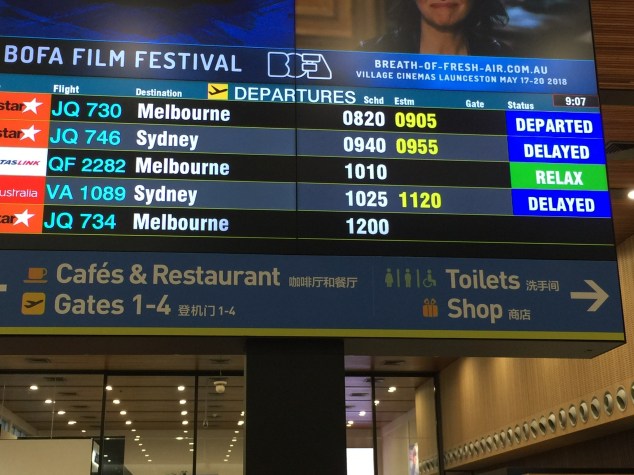
B9F41713-881B-4FB0-A79D-51CC1A7D02F6And, so, even though my bag didn’t make it when we did, it showed up eventually sporting lots of tags but no clue as to where it had gone!

5773F8B6-0997-4362-AB8D-D7E43E2F3A77Because of all the awful weather all flights to Sydney had been cancelled and the folks handling missing bags had a whole batch to send back to Sydney because there were no people accompanying them. Still can’t figure that one out!

Today we went into Melbourne and walked around the botanical gardens with our aboriginal guide.  We started with a smoke ceremony.
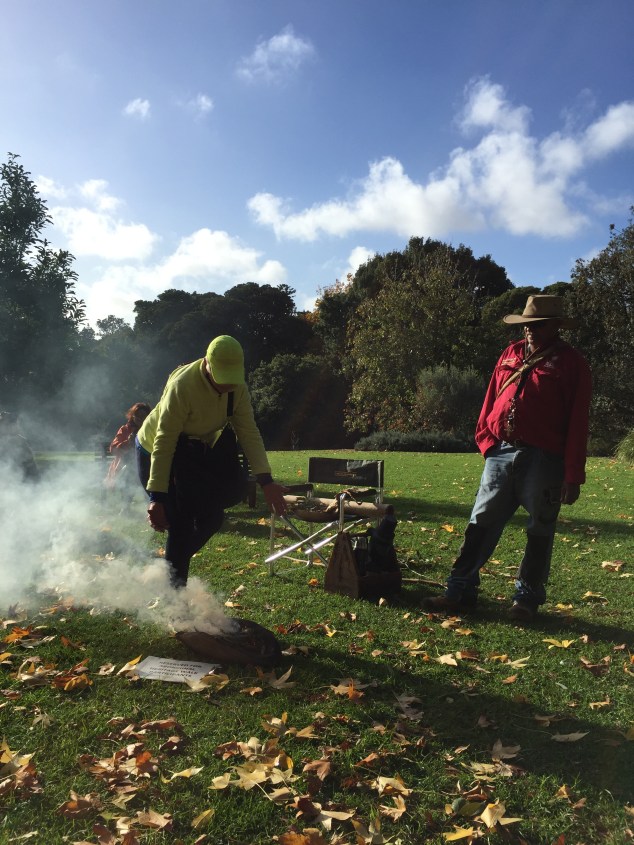
E82627D2-CFA7-477B-9287-693083C5012E.jpegVarious leaves are added to a small fire.  The leaves signify respect for what our elders have taught us, for the knowledge we pass on to our children, and for the lives we live in the present.  Cen’s whole lesson was that we must take care of the earth, our elders, and our children so we may receive care from them in return.

Next up was a walk through “alleys” in downtown Melbourne.  First, all the streets are named after someone. There is a street 99 feet wide named Bourne Street, for instance, and the next street is only 30 feet wide and named Little Bourne Street.  Why?  Because the wide streets had to be wide enough to turn around a horse and wagon, while the small street only had to be wide enough for goods to be delivered and customers to get to the shops.

The alleys are like the arcades or snugglewickets we saw in England. Most of these are covered and have lots of little shops lining them. The floors are fantastic ceramic inlaid floors, and the ceilings are decorated with ornate metalwork.

The thing with the metalwork made us wonder for a few days.  Many of the older houses have this lace-like adornment which rivals the houses of New Orleans. I’ll post pix later. But what we found out is that it was made from the ballast in the ships that brought these intrepid folks here!

When I get some good pictures of the gingerbread on the houses you’ll see just how beautiful it is!

To finish up with today’s activities, we went to the old Victoria Market. It spans several blocks and has anything you can think of.  Pretty cool!
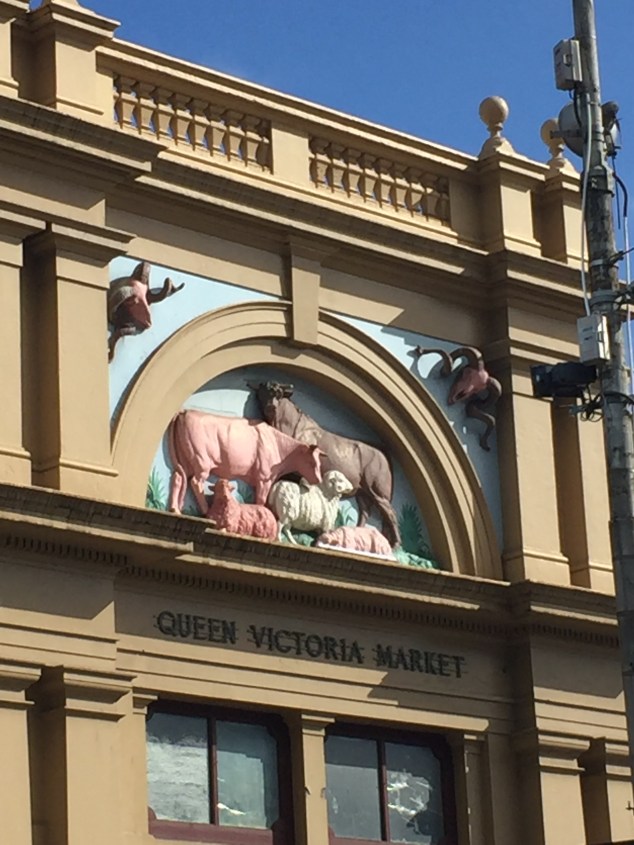
12DAA0AC-C487-45FE-A698-38AFE21ED88B.jpegAfter we walked through the market, Mark and I walked back to the hotel. We’re doing pretty well getting our 10,000 steps every day!!
PART THREE: HOBART TO LAUNCESTON VIA CRADLE MOUNTAIN

But first a word about words!  These Aussies talk funny. Vowels are drawn out so my name, for example, is said Kay-thie.  Whereas the Brits exclude whole parts of words, think Worcestershire sauce, these Aussies add syllables.  LAUNCESTON is pronounced lawn-cess-ton.  Bear is pronounced beer,” beer pronounced bee-ya, male pronounced “mile” and mile is pronounced kilometer.  Go figure!

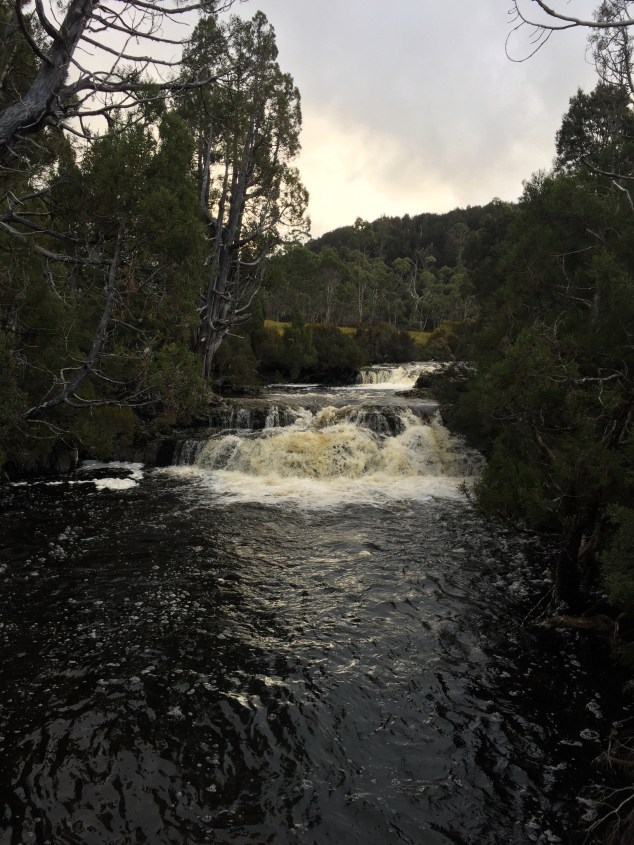
Another thing is the weather.  We are suffering high winds and frigid temperatures caused by an inflow of *antarctic* air from the south.  Believe me, they aren’t kidding!  Our trip to Cradle Mountain was made in the rain and wind.  Again, I cannot begin to describe how beautiful this country is.  22043AD7-936F-4505-AEED-06511616037E

The air is the purest in earth and so is the water.  Tasmania is run on hydropower so there is no pollution and the countryside is just pristine.

On our way we learned about wallabys and paddy melons, and more about wombats.  Little known fact about wombats in our part of the world, but a fact abundantly clear here, is that they poop squares.  Wallabys are know as wannabes because they are smaller than kangaroos, and paddy melons are a variety of wallabys that look like they’ve swallowed a melon.

Here they are, the wombat, two wallabys, and a Rufus wallaby, or paddy melon.

We hiked a trail in the rain the following morning and noted the genius idea of tacking chicken wire down over the board walks.  It kept us from slipping, which was a good thing! We also saw the chalet hand built by the guy who founded the park.  After his wife died he moved there full time and I have to tell you that living here in the winter would have been a stretch!  Oops, guess I didn’t get a pic of the chalet, but it’s not what you imagine.  Small, rambling, one fireplace, and lots of chinks which needed filling!

On to Launceston, the third oldest town in Tasmania.  Built along the Tamar River, it is a pretty town with a lot of Victorian charm.


The lovely Tamar River valley, Cataract Gorge, Mark holding up the suspension bridge, the bridge itself, and a long view of the river and rocks in this “beauty” place.

Next we drove to an aquarium where we met the monotremes, the platypus, and the echinid.

The platypus is a small animal, about two feet long.  They have thick fur with an air pocket on their backs and a flattish, spiny tail.  They are bottom feeders who close their eyes when they eat.  When they have a mouth full, they let the air in their backs pop them to the surface where they chew and swallow.  Each male has a spike on his back feet that he uses to inject a venom into his enemies. If you happen to be this enemy be prepared for a long life of pain because there is no anti venom.  Each male platypus has a different venom so science hasn’t been able to concoct a generic anti venom.  Yuck!

These little guys are echinids.  The white spikes on their backs are hard defensive spikes but they cannot throw them like porcupines.  They have a purple tongue which is as long as their body!  And they can clean a dish of food faster than our cats!

Tomorrow we fly to Melbourne and pick up the rest of the folks on our tour.  Sure hope those Antarctic winds subside!!

TASMANIA: PART TWO

What a beautiful island Tasmania is.  It was discovered in 1628 (maybe) by a Dutchman named Tasman.  That is all he did.  Just named it and kept on sailing.

Okay, Jeff, I know I spelled Arthur wrong.  But that’s the way it goes sometimes!  Today we drove about two hours to Port Arthur, location of the “Supermax” prison of the 1700’s.  Before we got there we saw Pirate’s Cove (next stop, Antarctica), the Tesselated Pavement (mysteriously cracked and symmetrical rocks), and Tasman’s Arch.

When we arrived in Port Arthur we were all astounded by the prison.  Built in the early 1700’s by convict labor, the buildings are massive.  Basically, the prisoners were treated as slaves who worked off their sentences by doing hard manual labor, training up for jobs when they were released, and trying to stay out of trouble so that their sentences were not extended.

The main prisoners quarters and  the church are being curated but not rebuilt.  The outer walls are still standing, but in insides are hollow.  The cell sizes are marked out on the floor inside and are tiny.  This type of tiny living was not good.  There are lots of other buildings still there and include houses of the staff, a post office, a whole bank of solitary cells, and an insane asylum.  Some of the more trusted inmates were allowed to make boats. And those who didn’t make it were buried in the Island of the Dead.  Spooky!

Tomorrow we head to Cradle Mountain where we will arrive after an all day drive.  We will go for a spotlighting tour at night looking for nocturnal animals, and we will enjoy a day and night without WiFi!  See you in a couple days,

ADVENTURE DOWN UNDER, TASMANIA

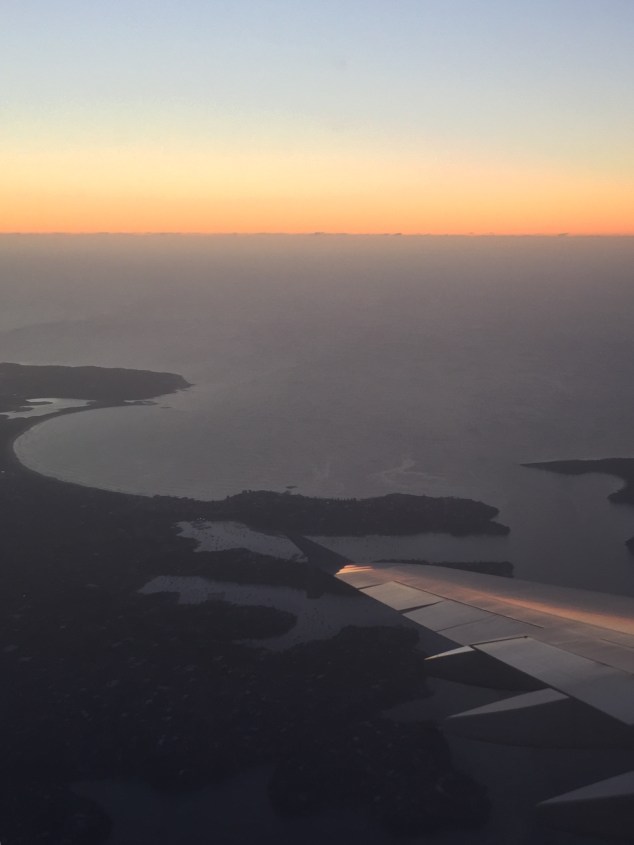
PART ONE. Not sure about this time travel stuff, but we left El Mirage on Thursday afternoon and got to Tasmania on Saturday afternoon.  A whole bunch of that time was spent in various airports, but the entire flight was in darkness.  We arrived over Australia at dawn.

C63EF2F4-B05D-47EA-8052-CF66FAB01E27When we got to Tasmania we had time for a shower and went to a local bistro for dinner, then hit the sack.  Who knew a person could sleep so well, so long.

With the morning came our first big adventure to Bonorong Animal Preserve.  Apparently there are a lot of car/animal mishaps here and this shelter takes care of the survivors.

We met a koala, a wombat, a Tasmanian devil, kangaroos, and an emu.  All these animals except the emu are marsupials.  When the mother gets run over you are always supposed to go out and check the pouch and make sure the “Joey” is alive and if so you take it to the shelter.  Who knew.

On a walk around Hobart we learned some of the area history.  Convicts were sent here from England in the 1700’s. The usual sentence time was 20 years but they were supposed to bring their families with them and work off their time doing projects such as bridge and building construction.  Some convicts had special skills such as one man who knew how to run a printing press.  His sentence was commuted and he became the local printer and a pub owner and a man of high standing in the community.

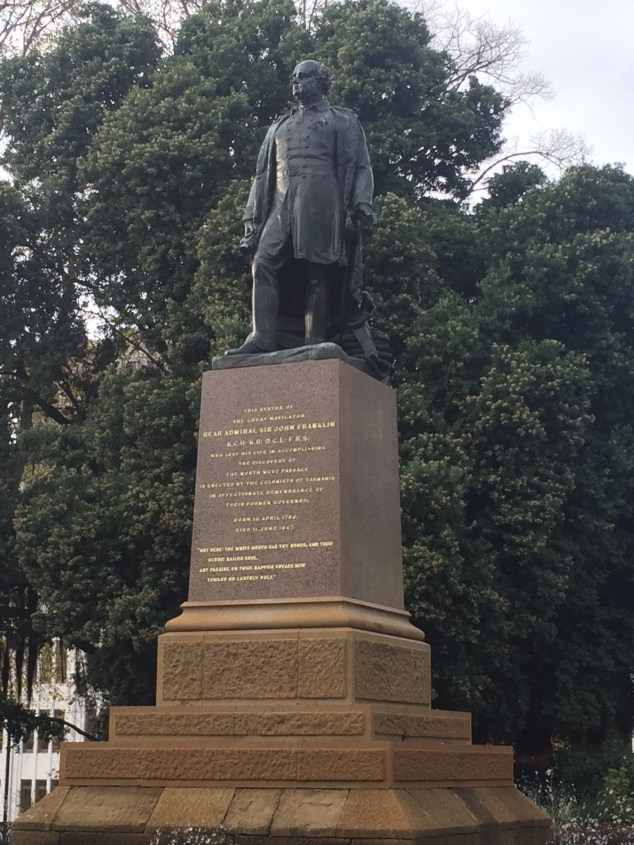
This lax handling of prisoners came to a screeching halt in  early 1778 when a new Governor General was assigned to the colony.  This guy reversed the kindly treatment of prisoners and started a much sterner regime.  He had a gallows erected and would sometimes hang 9 at a time.  The folks of Hobart (Australia’s second city) revolted and wanted to declare independence as had the American colonies.  King George wanted no more of this so he sent a different guy to replace the one everybody hated.  This new Governor General was Lord John Franklin who reinstated the more relaxed handling of prisoners.  The colonists loved this guy who was to later go on to hunt, unsuccessfully, for the Northwest Passage.  Did any of you watch The Terror?  It’s about him. Sorta.

41A805EA-B671-49E0-9CA9-28CF9B610BE6.jpegWe also looked up into the night sky and saw the Southern Cross.

692104B8-D9DE-4DF2-9731-664FE3053C18.jpegIt is this formation of four stars sesembling a kite.  There are two lower stars and when a line is drawn through the two right handed stars in the cross through the two below the line points to true south.  The statue in the background is of Tasman after whom the state is named.  And above is the flag with six stars denoting the six states of Australia.  One guy in our group could name them all, but not me!  I had a pen pal once in New South Wales so I knew that one, but none of the others.
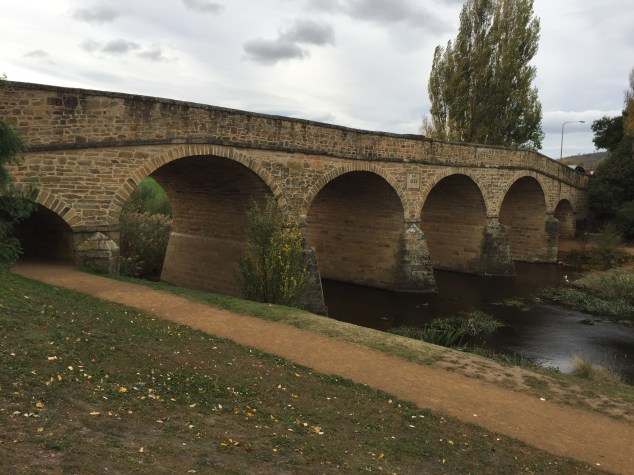
As our day wound up we went to the small town of Richmond.  It is very pretty and reminded us a little of the town of Niagara on the Lake in Canada.  There we saw this bridge built in 1823 by prisoners.  It is quite charming and we enjoyed a local lunch featuring “pie” which is a little individual quiche.  Mark had Shepard’s pie and I had cauliflower.  Very tasty!

C99D85A7-66CD-423D-8434-64FB421DE342.jpegThe weather has been extremely windy and cold.  But we are carrying on!  Tomorrow we go to Port Authur to see the prison where many of the convicts lived.  Until then, g’day Mates!!